I was told the stones might speak.
A friend had stood here a few months before I did and said she had received a message. So I came… listening.
And I heard.
I understood and felt a quiet, unmistakable knowing.
I also grasped that we understand far less about our beginnings than we think we do.
These stones, some from nearby, some carried from Wales, and now evidence that the central altar stone traveled from northeast Scotland, suggest something far more sophisticated than the tidy story we have been told. Coordination. Intention. A kind of ancient intelligence that predates the pyramids and gently unsettles the idea that civilization began only between the Tigris and Euphrates and spread from there. That fascinated me.
It doesn’t rewrite history so much as it humbles it.
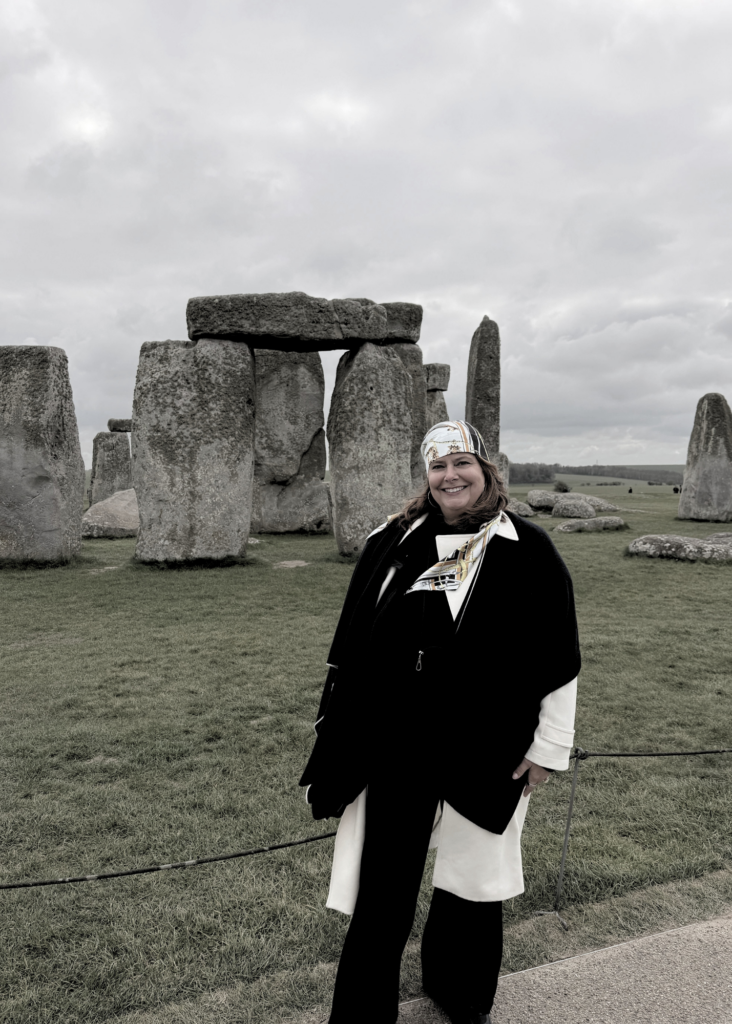
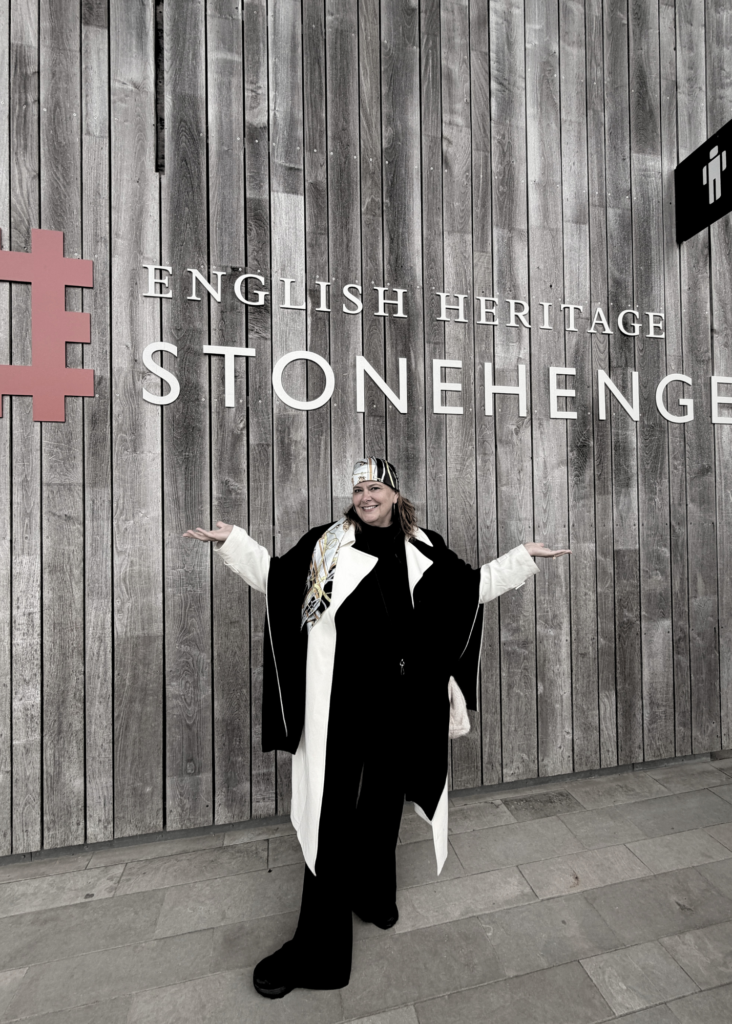
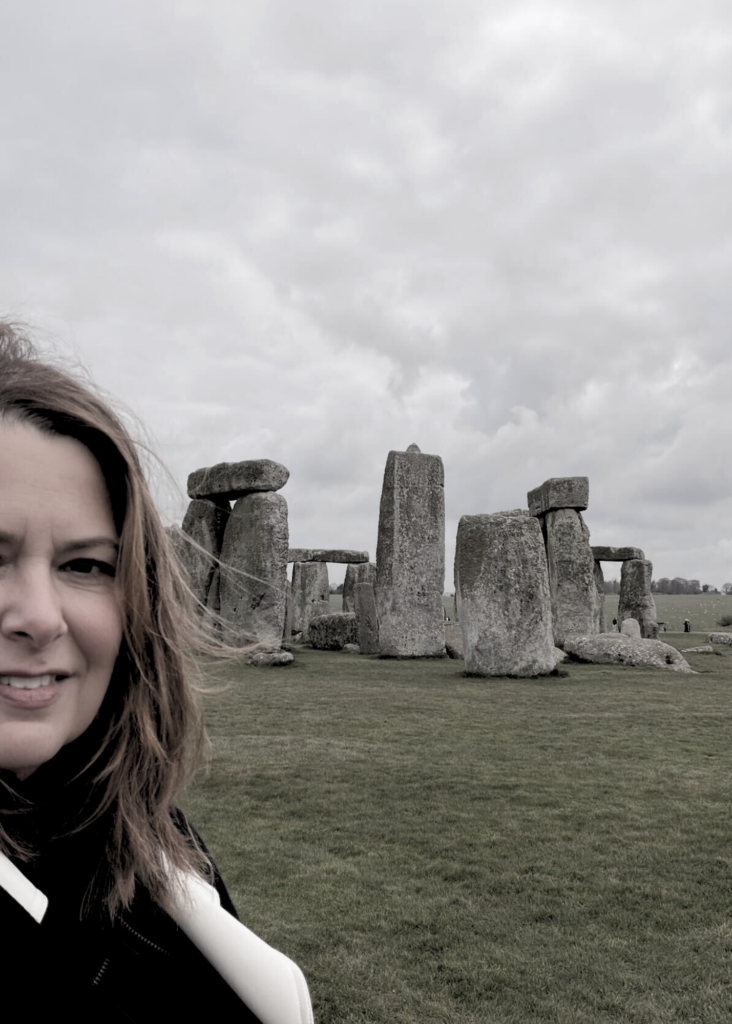
Standing here, I also thought of Tess of the d’Urbervilles, of that haunting ending, her final stillness among these stones.
A place of reckoning. Of surrender. Of truth that cannot be argued with.
And maybe that’s the message:
Not everything ancient is behind us. Some of what we need to know and hear is still waiting for us to catch up.
The Stones Themselves
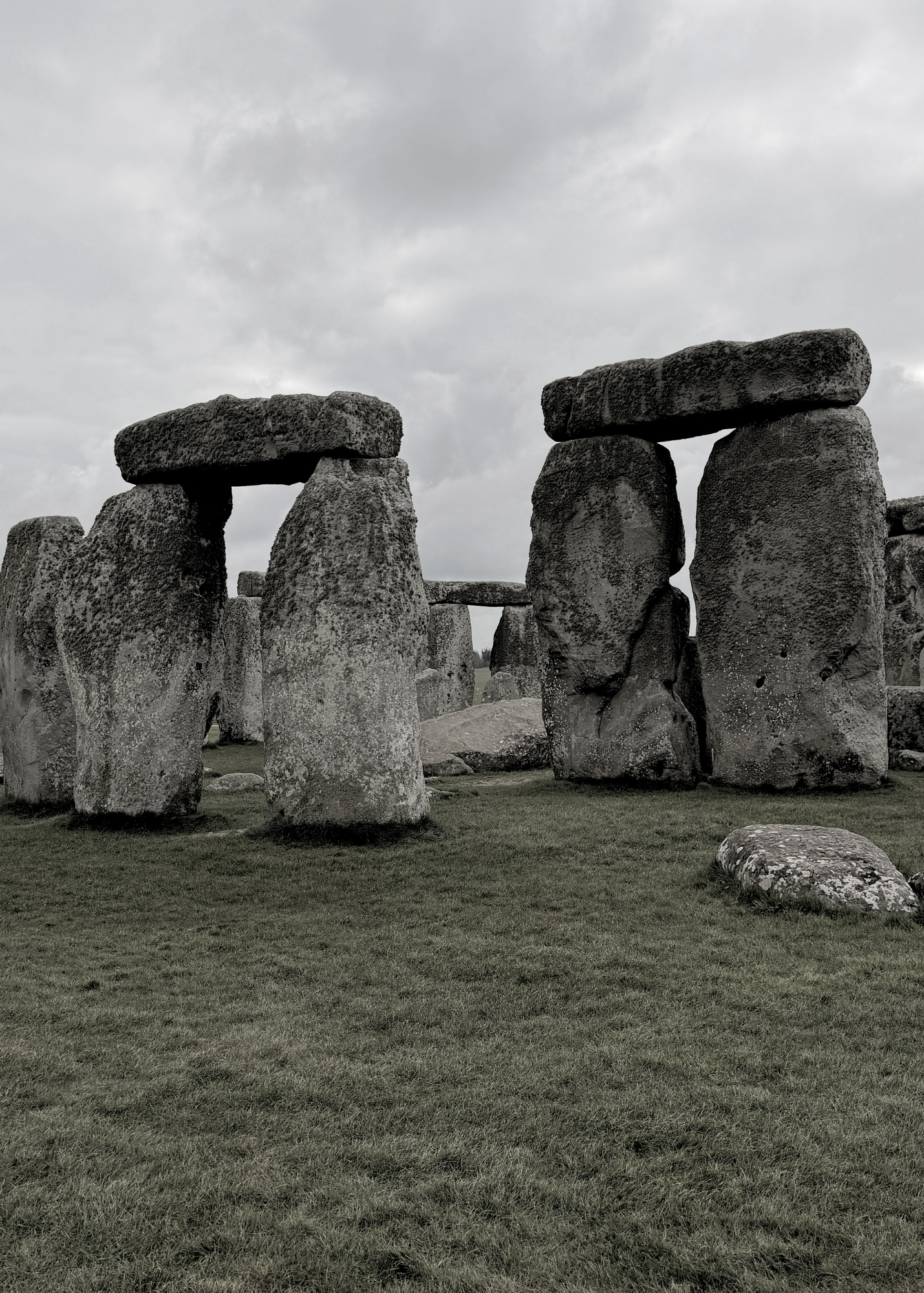
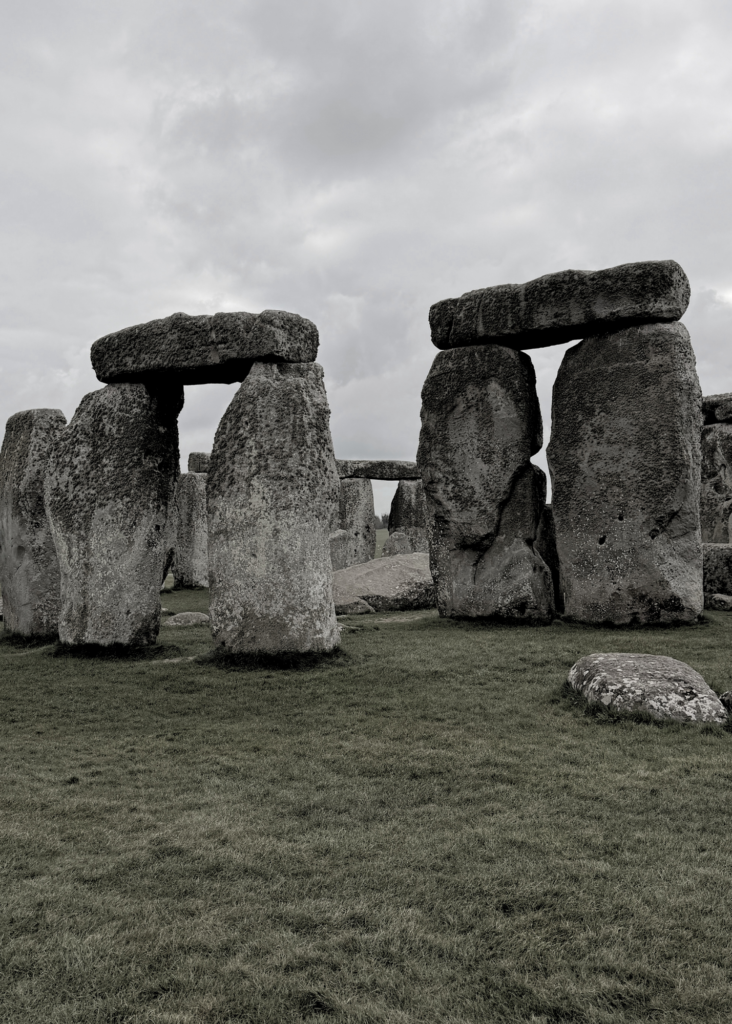
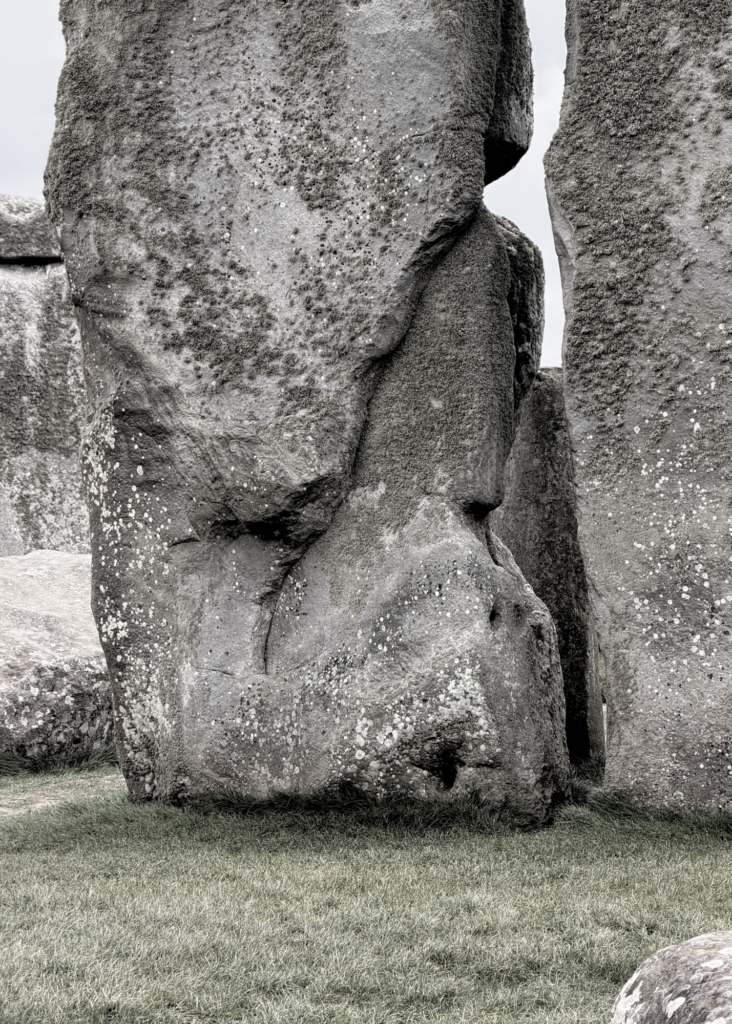
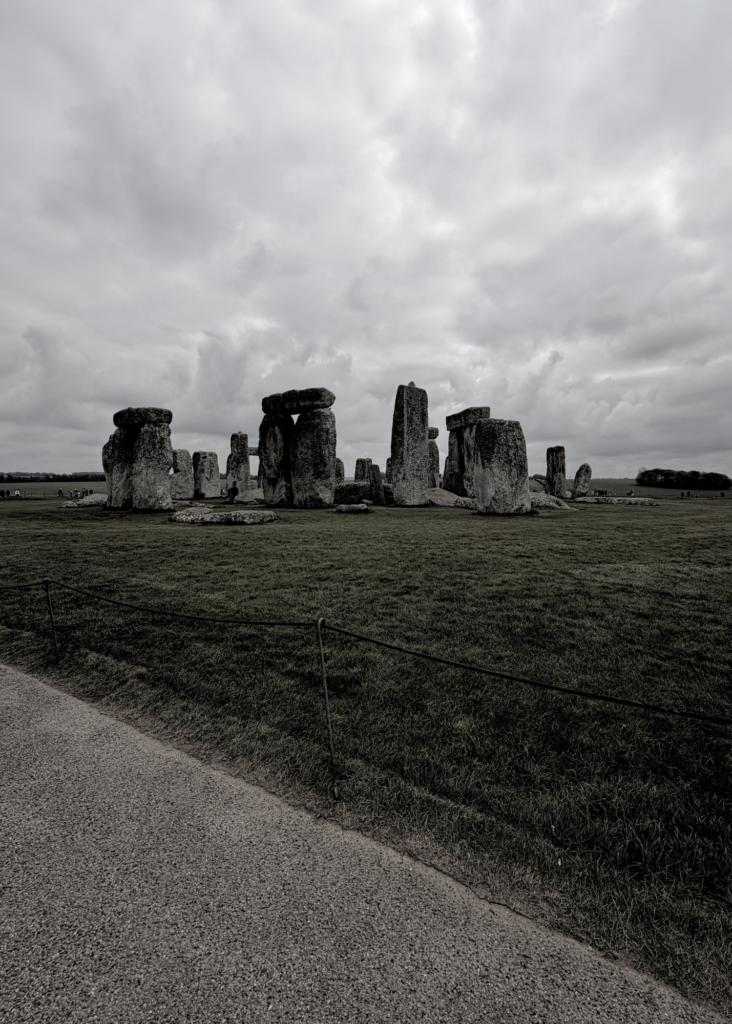
What stands at Stonehenge today is, as the visitor center says plainly, a ruined temple. The result of several episodes of construction separated by roughly four thousand years of destruction, decay, and human intervention. It is not the monument that was. It is what remains of something larger, stranger, and more intentional than we can fully reconstruct.
The museum is so well done and tells the story across five millennia.
Before Stonehenge, 3500 BC and earlier. Long before the first stone was raised, this landscape was already sacred. A man buried here between 3630 and 3360 BC, whose face has been forensically reconstructed from his skull and greets you at the museum entrance, died between the ages of 25 and 40. He stood 5 feet 8 inches tall, weighed roughly 154 pounds, was right-handed, and had traveled widely as a child. Chemical analysis of his teeth shows he was born at least 62 miles away, perhaps in south or west Britain. He had no signs of disease. At some point, he had injured his right leg. He was buried in a long barrow 0.8 miles from the Visitors Center, excavated in 1864 by Dr. John Thurnam.
He knew this land before Stonehenge existed.
3000 BC: A Sacred Enclosure. The first major construction was a large circular enclosure measuring 335 feet in diameter with two entrances. Inside it sat a ring of 56 pits now called the Aubrey Holes, named for the 17th-century antiquary John Aubrey, who first noted them as small depressions in the ground. These pits likely held upright pillars of stone or timber. Cremated human remains were placed within and around them.
2500 BC: A Spectacular Stone Circle. About 500 years after the enclosure was built, the monument underwent a transformation. Enormous sarsen stones, some weighing more than 30 tons, were raised into the iconic horseshoe and circle we recognize today, with smaller bluestones placed between them. The stones were aligned on the midsummer sunrise and midwinter sunset. The bluestones were brought over 178 miles from South Wales, transported mostly by boats along the sea and rivers. The sarsens, from north Wiltshire, were placed on timber sledges with rollers and dragged across the landscape, a feat that required hundreds of people. They were then shaped using hammerstones and fitted together using joinery techniques borrowed from woodworking. The completed monument was a masterpiece of engineering.
2200 BC: An Evolving Structure. Shortly after the stones were raised, an earthwork avenue was built leading to the entrance, connecting Stonehenge to the River Avon via a curving 1.7-mile route; its straight section near the monument was precisely aligned with the solstice. Around this time, the bluestones were rearranged again, the double arc dismantled, and the stones set in an outer circle and an inner oval. Some were later removed, leaving the horseshoe shape we see today. This was the last major phase of construction.
The Altar Stone: A Discovery That Changes Everything
For over a century, scientists believed that the flat central stone at the heart of Stonehenge came from Wales, consistent with the bluestones around it. We are still uncovering the history of Stonehenge.
But just two years ago, a fascinating 2024 study published in the journal Nature changed entirely. I learned about this new fact from the BBC. The Altar Stone was brought to the site from near the tip of northeast Scotland, a journey of more than 460 miles. Researchers suspect it was installed about 4,500 years ago, meaning Neolithic people moved this six-ton rock hundreds of miles before lightweight, spoked wheels were even invented.
Marine transport is considered the most likely method. The difficulty of long-distance overland transport from Scotland, given the need to navigate significant topographic barriers, suggests it was transported by sea, demonstrating a high level of societal organization across Britain during the Neolithic period. That’s a mind-blowing discovery.
That means the builders of Stonehenge were not a local tribe using local materials. They were coordinating across the entire length of Britain. Wales. Wiltshire. And now Scotland. Whatever this place was, it mattered to a very wide world, and the people who built it were more connected, more organized, and more intentional than we have long assumed.
Stonehenge did not stand alone.
It was the centerpiece of an entire ritual landscape. The builders likely lived at Durrington Walls, 2 miles northeast, where excavations have revealed small houses that were occupied while the stones were being raised. Also nearby are the timber circles at Woodhenge, a small henge at West Amesbury, long barrows stretching across the plain, the causewayed enclosure at Robin Hood’s Ball, and the Stonehenge Cursus.
After Stonehenge.
From around 2400 BC, activity shifted outward from the monument. People began burying their dead individually, with significant objects: beaker pottery and the earliest metal tools and weapons ever found in Britain. Some of the richest of these graves lie within a short distance of Stonehenge. One burial on Wilsford Down, just over a mile south, contained a bronze dagger, a ceremonial battle-axe of spotted dolerite, flint arrowheads, and two beaker pots, buried with a young man who died between 2470 and 2200 BC.
The monument endured. The world around it changed. And even today, the fields of the Salisbury plains are dotted with small and larger hills indicating ancient burials.
Who Looked. Who Dug. Who Theorized.
Stonehenge has attracted brilliant minds and spectacular misreadings in roughly equal measure, and that history is itself worth telling.
In 1620, King James I visited the nearby estate of the Earl of Pembroke at Wilton House and dispatched his royal architect to make sense of the strange ruins on the plain. The king, who was deeply invested in projecting legitimacy through historical lineage and had gone so far as to commission family trees tracing his descent from King Arthur, saw Stonehenge as a potential asset to that narrative — a monument of ancient power that, properly understood and claimed, could burnish the Stuart dynasty’s connection to the deep roots of Britain.
King James I also sent Inigo Jones, the famous architect and theatre designer, to make a study of the origin and purpose of Stonehenge. Jones was no minor figure. Often called “the English Palladio,” he was Surveyor of the King’s Works to both James I and Charles I, and the designer of court masques and royal buildings. He had studied in Italy, absorbed the precision of classical Roman architecture, and returned to England to introduce the Palladian style, building the Queen’s House in Greenwich and the Banqueting House in Whitehall, works that changed the course of British architecture entirely.
When he looked at Stonehenge, he looked with an architect’s eyes, and what he saw was geometry. Proportion. Symmetry. Jones concluded that, due to its “elegancy and proportion,” Stonehenge was constructed not by native Britons but by the Romans. He considered the Egyptians, Eastern nations, and the Greeks incapable of the precision the monument demonstrated. For Jones, it was a classical temple, dedicated to the Roman god Caelus.
He was wrong, as it turned out, by about three thousand years. The Romans did not arrive in Britain until Julius Caesar’s expedition in 55 BC; Stonehenge predates that event by millennia. But Jones’s survey, published posthumously in 1655 from his notes by his assistant John Webb, was the first serious architectural analysis of the monument and launched centuries of scholarly debate.
The misidentification says something interesting: a man who had dedicated his life to the study of classical proportion looked at a prehistoric monument and could only understand it through the lens of Rome. Every age, as one of those museum wall quotes says, has the Stonehenge it deserves.
That same 1620 visit had a less scholarly consequence. The first known excavation at Stonehenge, in the center of the monument, was undertaken in the 1620s by the Duke of Buckingham, prompted by the visit of King James I. George Villiers, the 1st Duke of Buckingham, dug a massive hole at the center looking for buried treasure, causing further instability to the already fragile stones. He found nothing of value. The monument that had stood for millennia nearly met its end at the hands of royal curiosity and aristocratic greed.
Who Owns These Stones? And Who Gave Them Away?
Stonehenge has passed through many hands. After centuries of changing private ownership, the monument went up for auction in September 1915 following the death of its owner, Sir Edmund Antrobus, whose son and heir had been killed in Belgium during World War I.
Cecil Chubb, a wealthy local barrister born only three miles from Stonehenge, entered the auction reportedly looking for dining chairs. When the auctioneer announced Lot 15, Stonehenge with thirty acres of adjoining downland, Chubb made an impulsive bid and purchased it for £6,600. He later told a local newspaper: “While I was in the room, I thought a Salisbury man ought to buy it, and that is how it was done.”
His wife, Mary, was reportedly not thrilled with the purchase, which may have made it easier for Chubb to gift Stonehenge to the British people on October 26, 1918. In his letter announcing the donation, he wrote:
“Stonehenge is perhaps the best known and the most interesting of our national monuments and has always appealed strongly to the British imagination. To me, who was born close to it and during my boyhood and youth visited it at all hours of the day and night, under every conceivable condition of weather, it always has had an inexpressible charm.”
The Deed of Gift stipulated that “the public shall have free access to the premises… on the payment of such reasonable sum per head not exceeding one shilling for each visit.” In gratitude, Chubb was made a baronet in 1919.
Here is where the story gets interesting. English Heritage, which now manages the monument, charges adults upward of £25 to visit. How does that square with Chubb’s condition of free public access?
The 1918 Deed of Gift did not specifically provide for free access for local residents, but at that time, public rights of way ran very close to the stones. These proved inconvenient to manage, and in 1921, the Commissioners of Works reached an agreement: the rights of way would be diverted, in exchange for granting residents of the surrounding parishes permanent free admission at all times.
That arrangement holds today. Around 30,000 of the 1.3 million people who visit annually enter free of charge as local residents, thanks to the impulse buy of Stonehenge’s last private owner. For everyone else, the admission fee stands.
Four Times a Year, the Rope Comes Down
Stonehenge is normally roped off. You view the stones from a respectful distance. But four times a year, at each solstice and each equinox, English Heritage opens what it calls Managed Open Access, and at those times the rope comes down, the fencing opens, and anyone who wishes can walk directly among the stones at dawn, free of charge.
Special access is granted only on the mornings of the summer and winter solstices and the spring and autumn equinoxes. Anyone can turn up, but you’re not allowed to touch or climb on the stones. Glass bottles, pets, and amplified music are prohibited. Access begins at first light, typically around 5:45 am, and closes by 8:30am, after which the site returns to its normal ticketed hours.
The summer solstice draws tens of thousands. The open access at the times of the equinoxes attracts fewer people, in the several hundreds rather than tens of thousands. And there are modern Druid ceremonies held in the circle around dawn. The winter solstice is the quieter, more contemplative gathering, the crowd smaller, the mood more internal, the darkness giving way to a cold, pale light over the plain.
Druids, pagans, tourists, pilgrims, and people who simply feel called: they all arrive. Anyone who has witnessed the crowd become silent as the sky begins to brighten can attest that it is something close to a spiritual experience.
The stones were aligned on this light five thousand years ago. I could hardly get my mind around that.
The Question That Remains
The most striking installation in the visitor center is not any artifact. It is a tall panel near the entrance, letters cut into dark material:
“The purpose of Stonehenge is lost to us. There will always be debate about its meaning.”
And a wall of quotes from writers, archaeologists, and poets across the centuries:
“God knows what their use was!” — Samuel Pepys, 1668
“Every age has the Stonehenge it deserves, or desires” — Jacquetta Hawkes, archaeologist, 1967
“The stones that defy time by never standing still” — Mike Pitts, archaeologist, 2000
“What is Stonehenge? It is the roofless past” — Siegfried Sassoon, 1928
“One might almost suppose that it was specially designed to accommodate every notion that could possibly be projected onto it” — John Michell, writer, 1981
That last one made me laugh. And then it made me think.
Tess at the Stones
Thomas Hardy set the final, devastating scene of Tess of the d’Urbervilles here: Tess and Angel, fugitives, resting among the stones at dawn. It was Hardy’s 1891 ending that first burned this image into my imagination, and the screen has brought it to life three times over.
Roman Polanski’s 1979 epic Tess starred Nastassja Kinski, Peter Firth, and Leigh Lawson, with a screenplay by Polanski, Gérard Brach, and John Brownjohn. It won three Academy Awards, including Best Cinematography. The film carried its own private weight: Polanski dedicated it to his wife Sharon Tate, who had given him the novel just before her murder in 1969 and had expressed interest in playing Tess herself. The nuns at my Catholic school showed us the film in the early 1980s.
Then in 1998, London Weekend Television produced a three-hour miniseries directed by Ian Sharp, starring Justine Waddell as Tess, Jason Flemyng as Alec, and Oliver Milburn as Angel. Many Hardy devotees consider it the finest screen adaptation of his work.
The 2008 BBC adaptation, written by David Nicholls and directed by David Blair, featured Gemma Arterton as Tess, Hans Matheson as Alec, and a then-emerging Eddie Redmayne as Angel. Nicholls described the farewell scene at Stonehenge as “the most moving scene in English literature,” and said recreating it at dawn, on location, at the correct time of year, was tremendously exciting.
It certainly has haunted me since I first saw the stones in the 1979 film as a teenager.
Three adaptations. The same stones. The same impossible stillness.
Hardy chose this place for a reason. A monument whose meaning cannot be agreed upon, as the final resting point for a woman whose life could not be judged by the rules that surrounded her. The purpose of Stonehenge is lost to us. Perhaps that was precisely his point.
What I Left With
The museum’s opening installation declares: Stonehenge is a masterpiece of engineering, built by sophisticated people.
That word, sophisticated, felt like a quiet correction and as a gentle rebuke of the long assumption that prehistoric meant primitive.
These were people who organized the transport of 30-ton stones across hundreds of miles, who calibrated solstice alignments with precision, who built a ritual landscape spanning miles, who coordinated with communities from Wales to the tip of Scotland, who knew their dead by name and buried them with ceremony.
They were not behind us.
And the stones are not behind us either.
I came listening. And what I heard was this: some wisdom is not lost. It is waiting to be uncovered.