Bath, the Royal Crescent, an Abbey That Shaped Every Coronation Since, and Why You Need More Than a Day
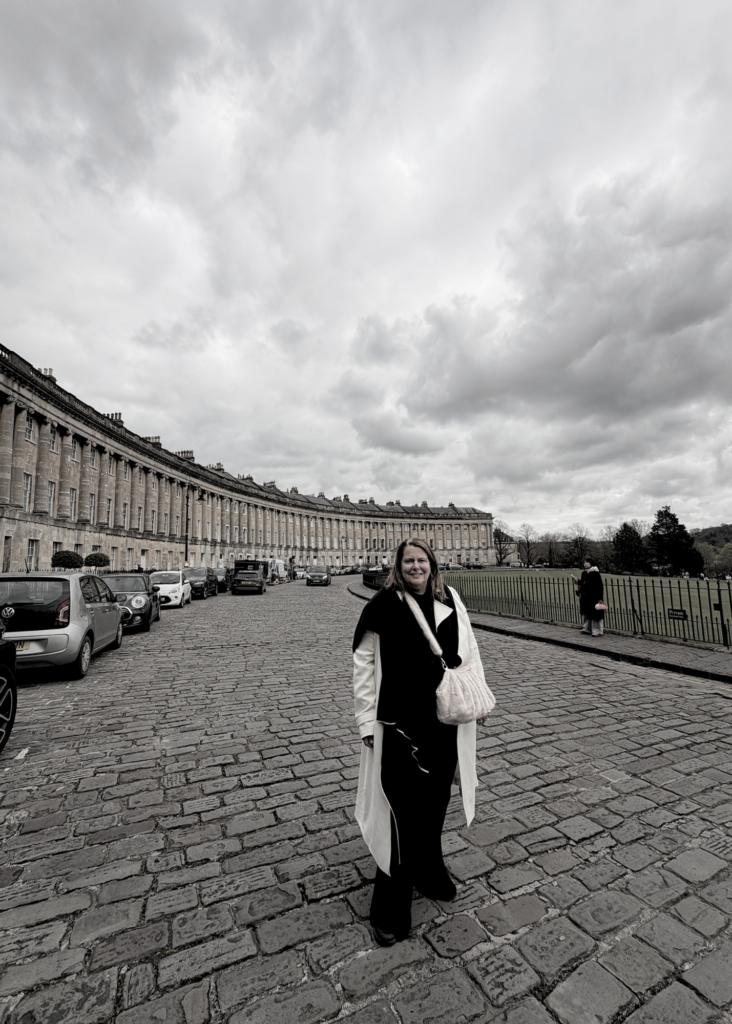
I stood at the Royal Crescent and felt time fold. I was sort of hoping I’d fall through time a la Claire Beauchamp Randall Fraser! (That’s an Outlander reference for those of you who’ve never felt droughtlander.)
That is the only way I know how to describe it. You turn a corner in Bath, and suddenly there IT is: that great sweeping arc of honey-colored Bath stone, thirty houses unified behind a single neoclassical facade, 114 Ionic columns, cobblestones curving away in both directions. Seen in so many films and British television series, this wonder was designed and completed by this unabashed anglophile, John Wood the Younger, in 1774. It’s truly one of the most beautiful streets in England. Possibly in the world.
I had seen it on screen so many times before. But photographs do not prepare you for its scale. Nothing does.
This Is Jane Austen’s Bath
Jane Austen lived in Bath from 1801 to 1806, first as a visitor, later as what her biographers delicately call a reluctant resident. When her parents announced the family was moving to Bath, she is said to have fainted. She did not love it here.
She didn’t live on the Crescent. The Austens were genteel but not grand. Gay Street and Trim Street were more their register. But everyone in Bath society knew the Royal Crescent. You couldn’t not. It was the apex of the social architecture, the place where the most fashionable people promenaded, where being seen was itself the point. Austen walked past it, observed the people who inhabited it, and filed everything away.
Northanger Abbey and Persuasion are set amid these streets and in these assembly rooms. She moved among people, showcasing their status and performing “wellness” centuries before our own era’s obsession with both.
However, Austen was not only an inhabitant. She was the observer. Which, if you know Austen at all, is exactly where her power lived. Oh, where is the satirical Austen of our times?
Persuasion is my absolute favorite Austen novel. The 2007 ITV adaptation with Rupert Penry-Jones is one of my favorite films, full stop. I have watched it more times than I will admit here. So standing on those cobblestones at the Royal Crescent, looking down that impossible sweep of honey-colored Bath stone, was one of those moments when a place you have loved on screen suddenly becomes real beneath your feet. The scale of it. The curve of it. The way the light fell flat and grey and beautiful over the whole thing, exactly as it looks in the film, because Bath in April is apparently Bath in April regardless of the century.
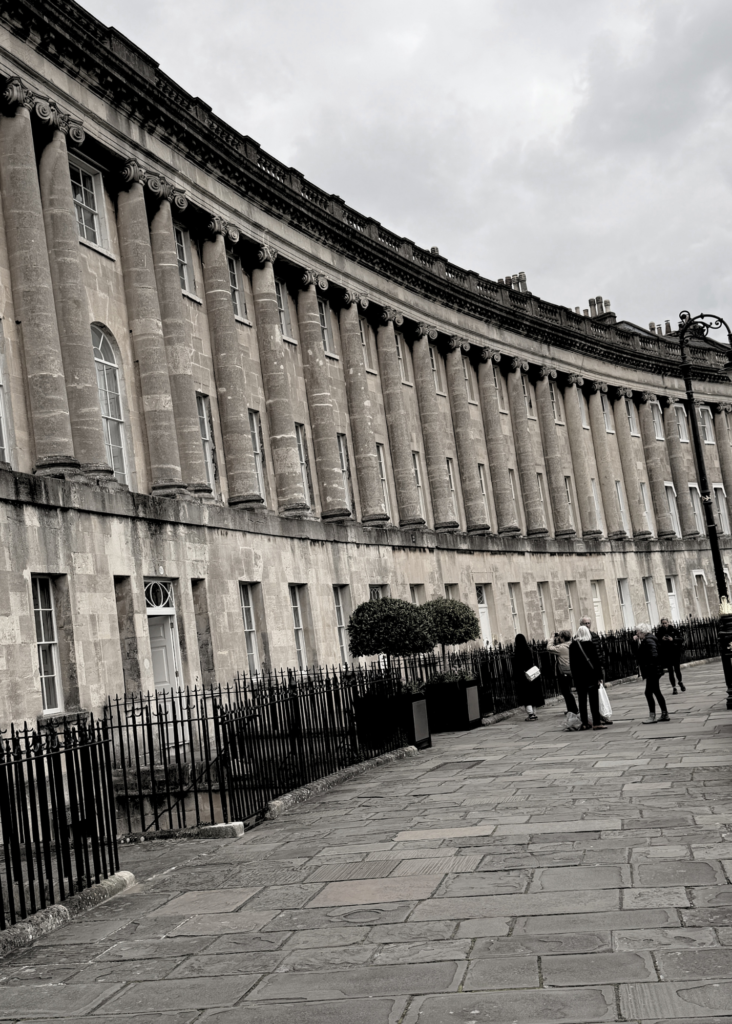
I stood there longer than I had planned to. I didn’t mind at all.
It is worth noting, for those who love Austen as I do, that she is not buried in Bath. She is buried in Winchester Cathedral, in the nave, under a plain black ledger stone that makes no mention of her novels whatsoever, only her personal virtues. Her family added a brass plaque later acknowledging the writing. Winchester Cathedral is also, as it happens, where Anglo-Saxon kings were crowned before the Norman Conquest moved that ceremony elsewhere. Even in death, Austen occupies a place layered with history she would have known exactly what to do with.
The Jane Austen Center sits on Gay Street in Bath, near where she actually lived. I did not get there this time, but I hope to next!
Tea at the Royal Crescent Hotel
After the Roman Baths, I went to tea at the Royal Crescent Hotel, and I want to be clear that this is not simply a recommendation. It is an experience that belongs in a category of its own. Quietly magnificent. Unhurried. The kind of afternoon that makes you understand why people came to Bath not just for the waters but for the particular quality of time this city seems to generate. The food was delicious. So was the tea. So was simply being there.
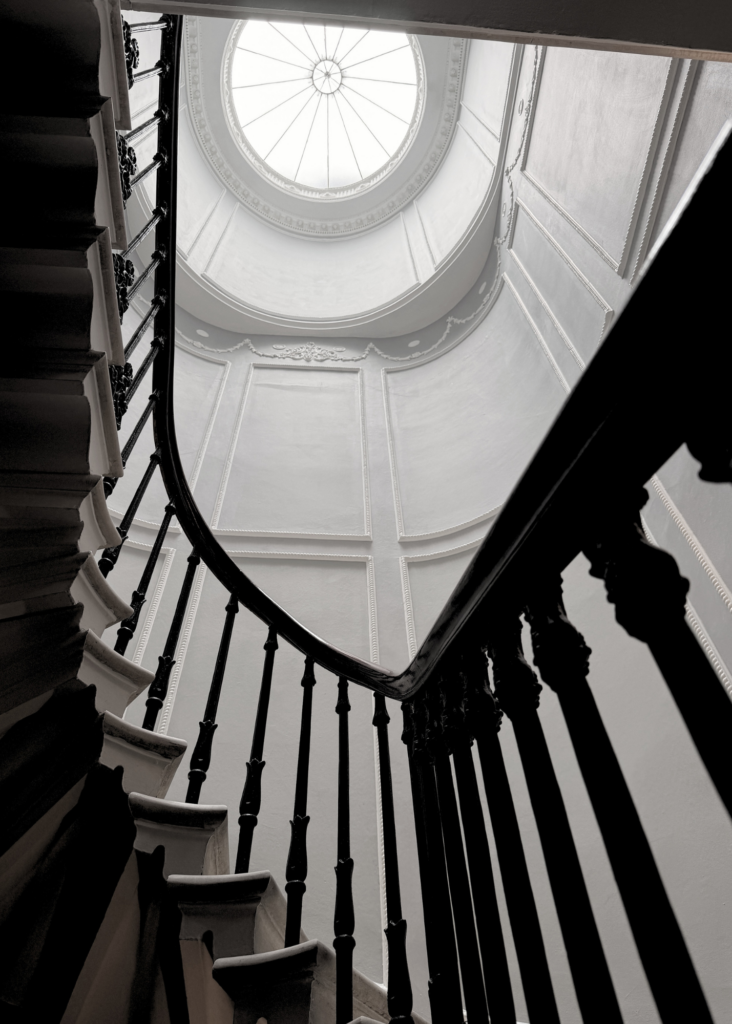
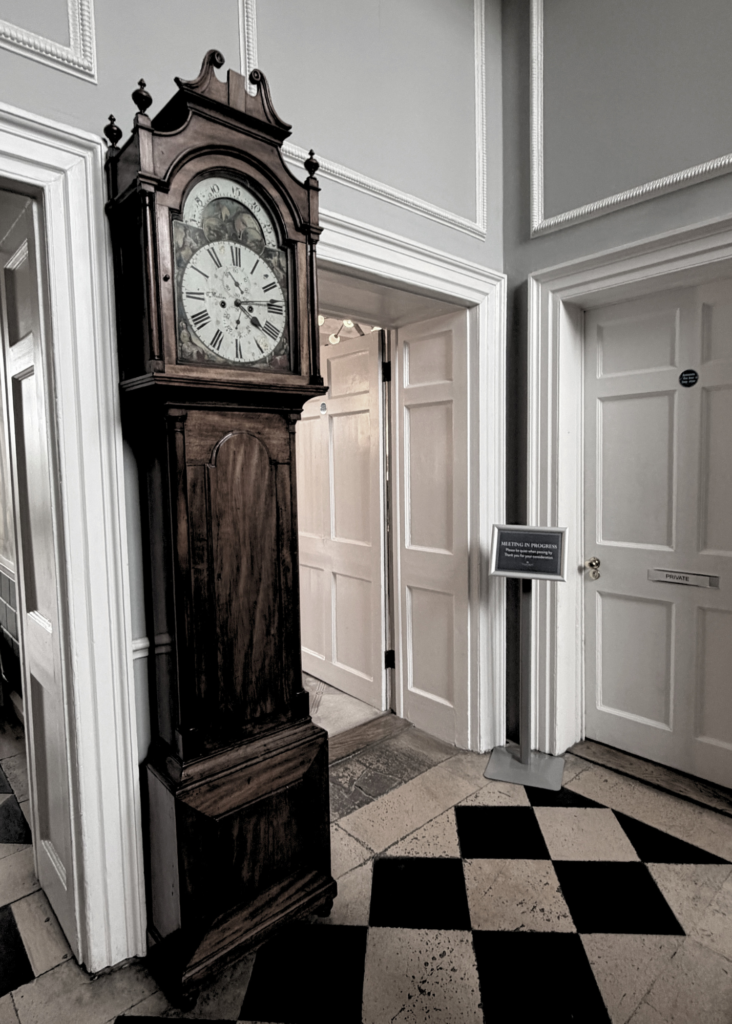
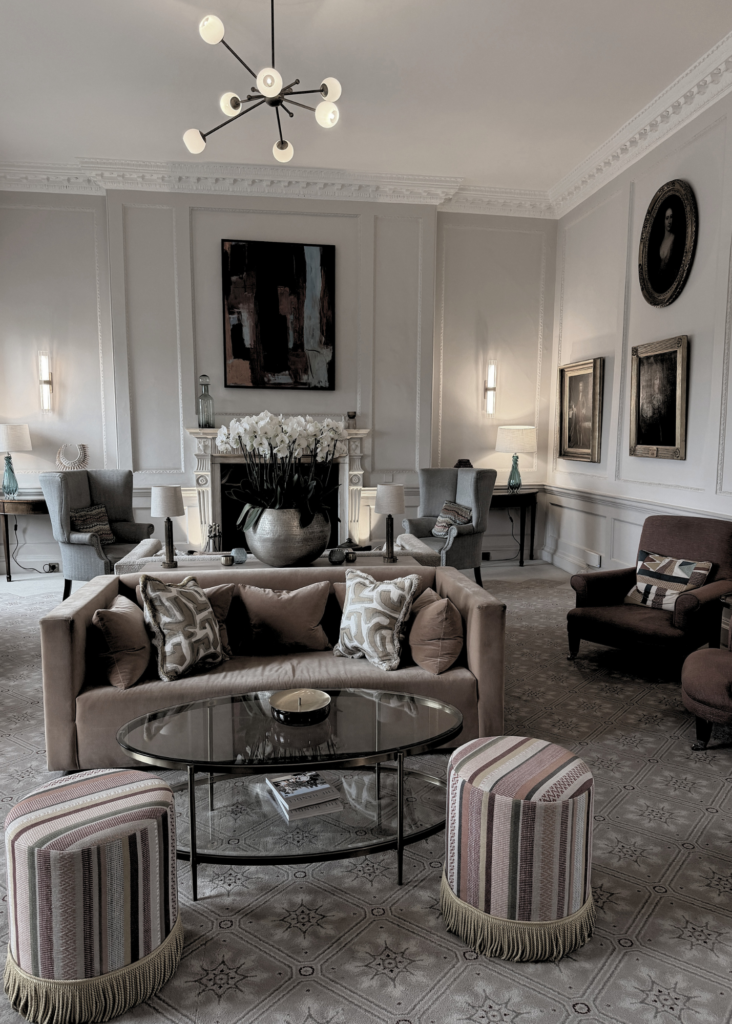
And it was in my bathroom at the hotel, because of course it was, that I found the images that made everything click into place.
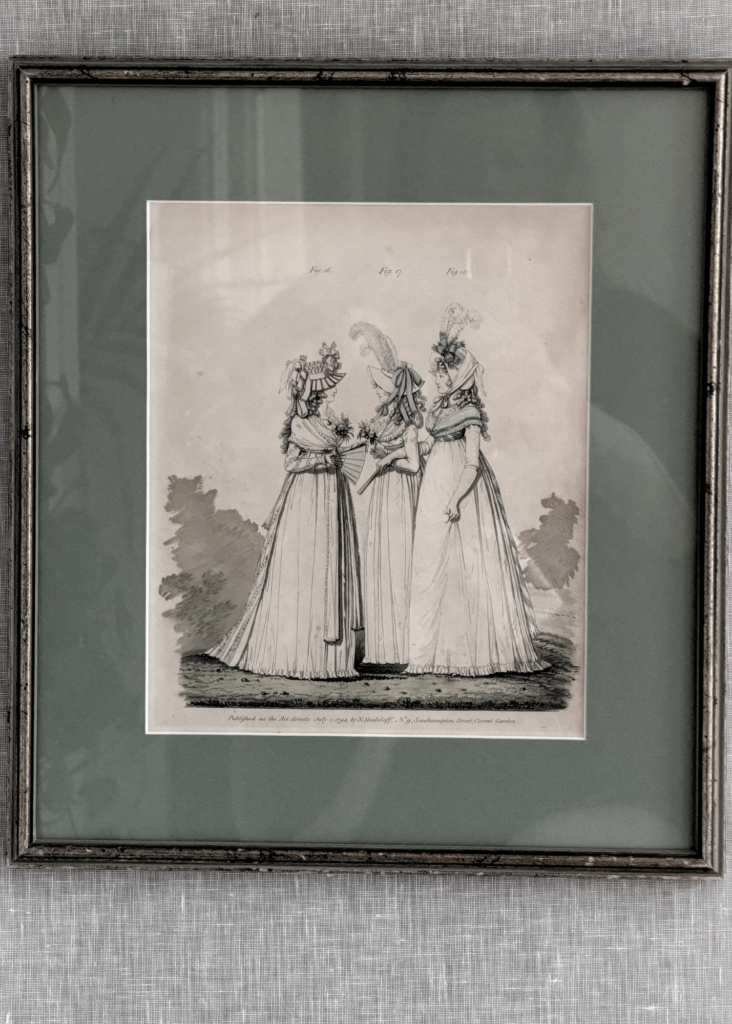
A framed 1794 Heideloff fashion plate on the wall: three Georgian women in empire-waist gowns and towering plumed hats, conferring in a garden. Figures straight out of an Austen novel, dressed for a world where what you wore to take the waters was a statement about who you were and who you intended to become.
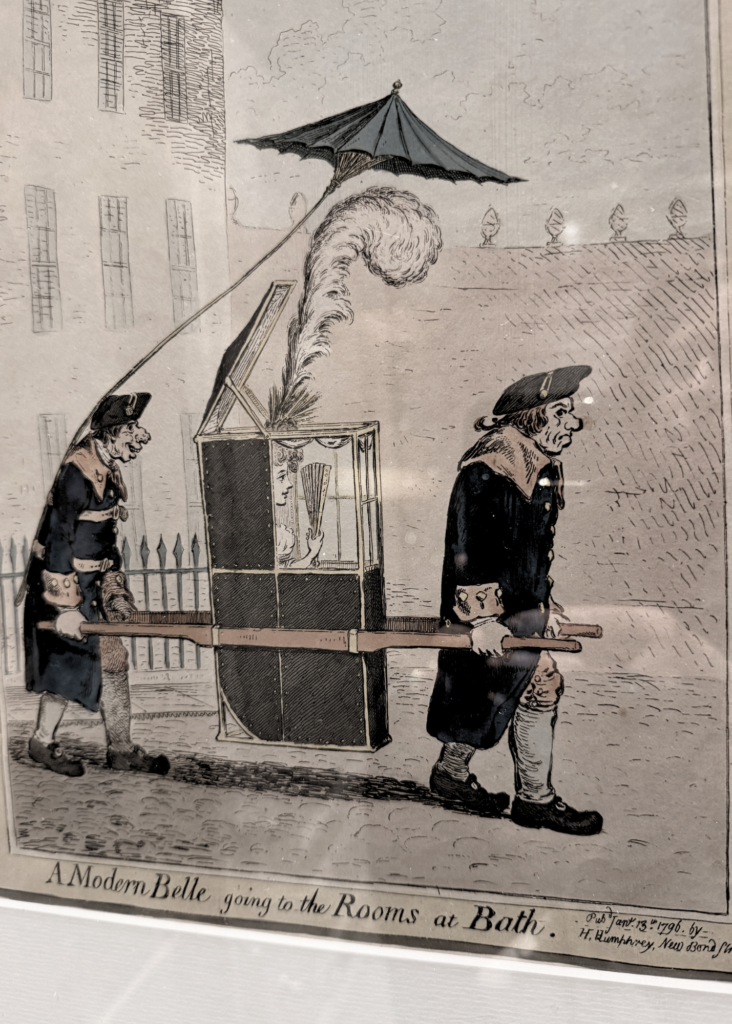
On another wall, the 1796 satirical print, A Modern Belle Going to the Rooms at Bath. A society lady being carried through these very streets in an enclosed glass sedan chair by two livery-clad bearers, parasol aloft, steam curling from her carriage. Published by H. Humphrey of New Bond Street. Pure Georgian social comedy.
There is so darn something perfect about encountering those images there, in a bathroom, in the Royal Crescent, in the very building where those women once promenaded. The joke Humphrey was making in 1796 is still completely legible. The distance between then and now collapses in the most delightful way.
Bath does that to you. It folds time.
A Warm Drink and a Cobblestone Square
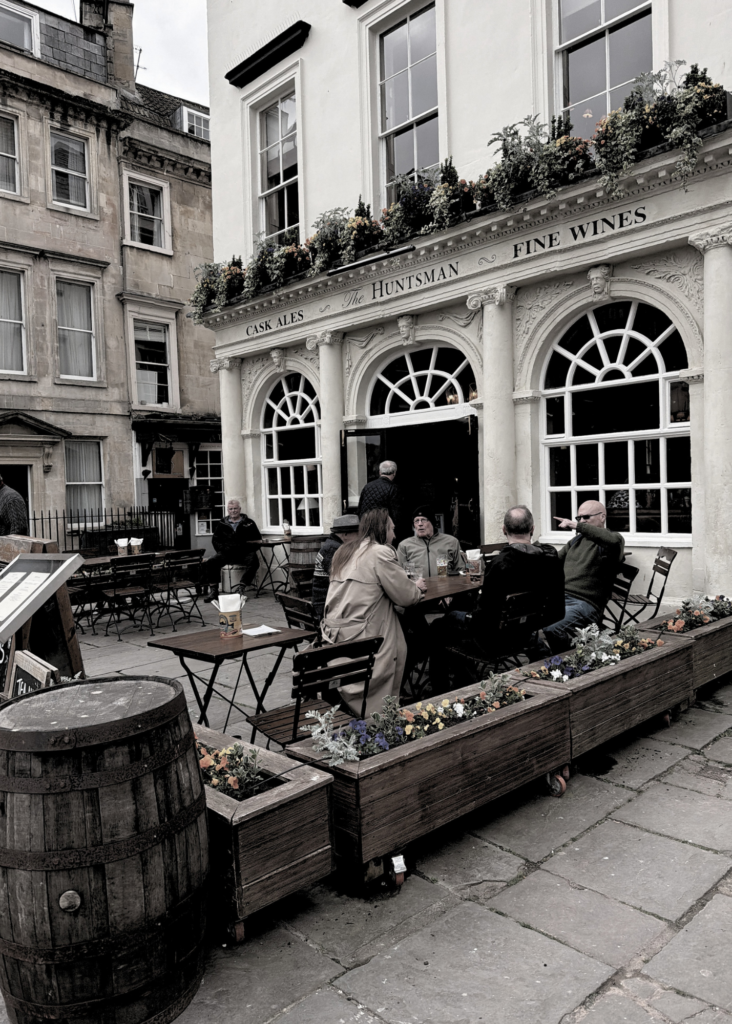
Before tea, we stopped at The Huntsman, a cask ale and fine wines pub tucked into one of Bath’s cobblestone squares, flower boxes spilling over the facade, a barrel out front, outdoor tables full despite the grey April sky. The kind of place that has clearly always been there and intends to remain. It’s fantastic. We had something warm and watched the city go about its business. Sometimes that is exactly the right thing to do in a place this old. Just stop. Observe. Let it settle around you.
Austen would have approved.
The Abbey I Did Not Enter
I stood at the west front of Bath Abbey, looking up.
I did not go inside. This is, I will confess, the second time I have been to Bath without going inside the Abbey, and I have made myself a firm promise that it will not happen a third time. Because even from the outside, even just standing at those doors, the building commands something from you.
The west front is extraordinary. Stone angels climbing ladders between heaven and earth, carved into the facade in the early 16th century. The story behind them is this: Oliver King, Bishop of Bath and Wells, had a dream or vision in which he saw angels, an olive tree, and a crown, and heard a voice saying, “Let an Olive establish a crown and let a King restore the Church.” The angels on the front of the Abbey are said to refer to that dream. There is a crown, an olive tree, and a bishop’s miter on the west front in his honor. A building that began with a vision, literally.
Bath Abbey was founded in the 7th century. It was reorganized in the 10th century, rebuilt in the 12th, and the current building dates largely from 1499. Its fan vaulting, completed by Henry VII’s master builders, the Vertue brothers, in the early 1500s, is considered one of the finest examples in England.
But the moment in its history that stops me entirely is this.
The Coronation That Shaped Every Coronation Since
On Whit Sunday, May 11, 973 AD, King Edgar was crowned King of All England in Bath Abbey. He had actually been king for 14 years, since 959. The delay was deliberate. Archbishop Dunstan, who compiled the coronation service himself, would not agree to crown Edgar until he had amended his ways. One 12th-century prior wrote simply that Edgar waited until he had outgrown the passions of his youth.
When the ceremony finally happened, it was the culmination of a reign. A statement. Edgar was not just the King of England. He was the overlord of Britain. Shortly after the coronation, he traveled north to Chester, where eight sub-kings, including the King of Scots and the King of Strathclyde, pledged their allegiance to him. Legend says they rowed him up the River Dee in his state barge.
The service Dunstan devised for that ceremony in Bath Abbey has been used, in its essential form, at every single British coronation since. Every one. Including the coronation of Charles III.
In 1973, Queen Elizabeth II visited Bath Abbey for a service marking the 1,000th anniversary of Edgar’s coronation. There is a stone on the Abbey floor commemorating that visit.
And then there is Alphege.
An Anglo-Saxon monk who was head of the Abbey in 980, Alphege went on to become Bishop of Winchester and then Archbishop of Canterbury. In 1011, when Canterbury was invaded by the Danes, they imprisoned him and demanded a £3,000 ransom. Alphege refused to pay. He refused to let his friends pay for him either. The Danes were so enraged that they clubbed him to death with ox bones.
He was later canonized. His feast day is April 19th.
Bath Abbey contains nearly 1,500 monuments, one of the largest collections in the UK, with 617 wall memorials and 847 floor stones. The building has been described as the lantern of the west, for the extraordinary amount of light its windows allow in. I will see that for myself next time.
The Cotswold Way
Stonehenge sits within easy reach of this same corner of England, and it asks something different of you than Bath does. I wrote about that in What Stonehenge Knows.
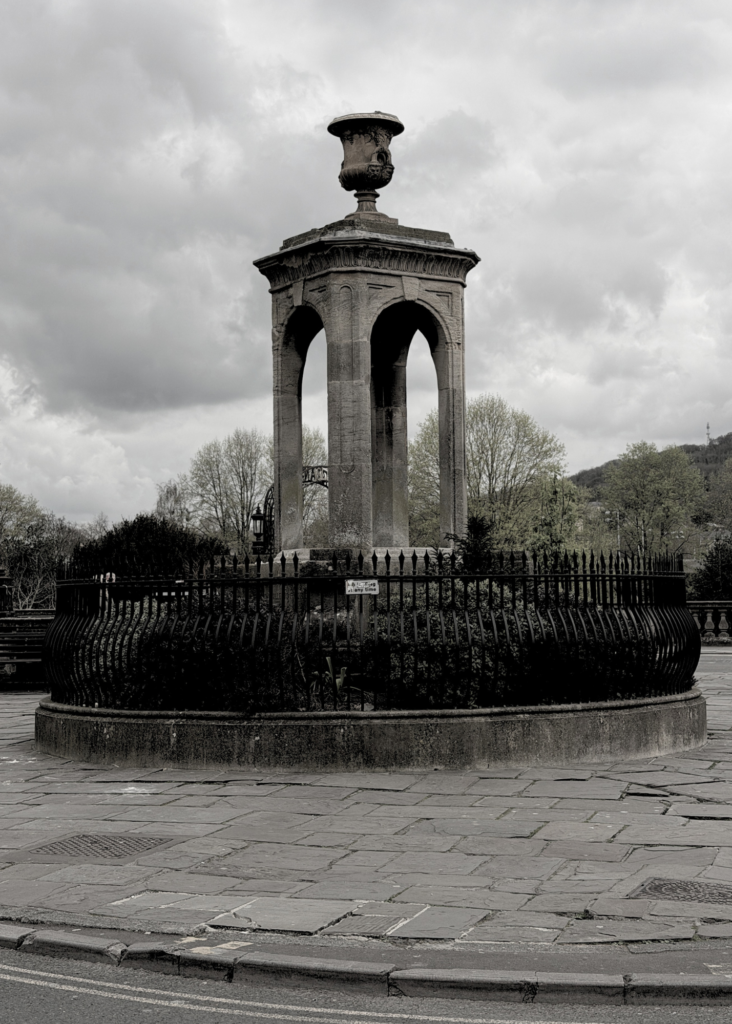
Set into the pavement near the Abbey is a circular stone marker. It is the start, or the end, of the Cotswold Way National Trail: 102 miles from Bath to Chipping Campden through some of the most beautiful landscapes in England, passing Sodbury Camp, Prospect Stile, Lansdown Battlefield, Dyrham, Coopers Hill, Painswick Church, and the River Severn along the way.
Bath is not just a destination. It is a threshold. A place where things begin. And where things end. The Cotswold Way National Trail is very popular at the moment, as is the Cotswolds generally. I loved visiting the site of the Battle of Evesham with my parents back in 1999. The Battle of Evesham (1265) took place on the northern edge of the Cotswolds between Simon de Montfort and King Edward I. A bend in the Avon River trapped Simon de Montfort, and he died there. (I’m a big Simon de Montfort fan)
What I’d Tell You
When I design an itinerary for my clients to see Bath, I recommend at least 2 days. One morning at the Roman Baths. An afternoon at the Royal Crescent, with tea at the hotel if you can manage it, and a warm drink somewhere with cobblestones and flower boxes, and people watching. Time at the Abbey, inside this time, looking up at the fan vaulting and the angels on the west front and the floor stone marking where a queen once stood to honor a king crowned here a thousand years before her.
In Bath, you can walk the streets Austen walked. Though she is not buried here, she is absolutely here. In the architecture, in the light, in the ancient stones and old buildings. She saw it all, and she wrote it all down.
The water has always been here. So has the stone. So have the angels on the wall, climbing their ladders, going nowhere and everywhere at once.
Bath does not reward the hurried visit. It rewards the person who slows down, looks up, and lets two thousand years of accumulated meaning do what it has always done.
It gets into you. Like the water. Like it always has.
There’s another layer to Bath underneath the one Austen walked on, literally. I wrote about it in Bath, Beneath.